
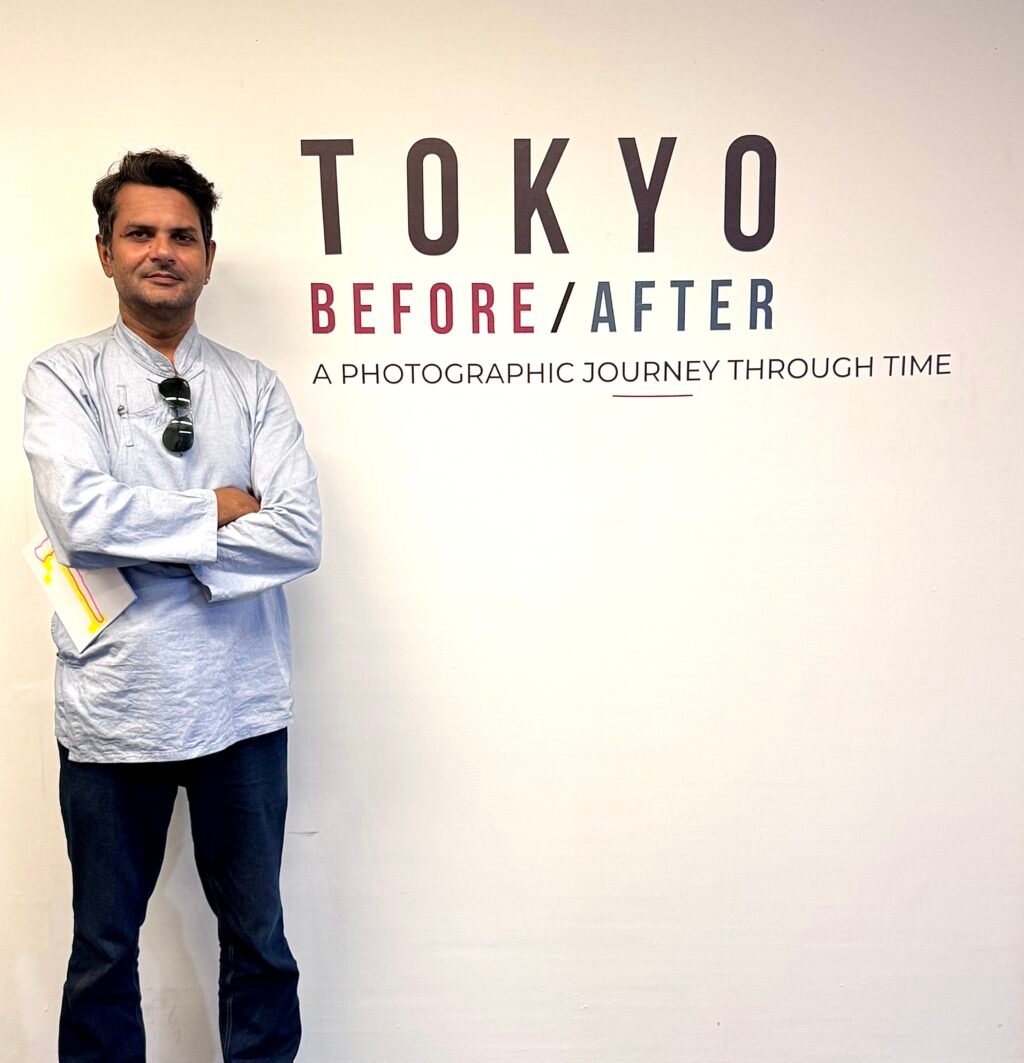
Tokyo Before/After at the National Gallery of Modern Art, Delhi
Tokyo Before/AfterA City Remembered, Reimagined and Reframed
At the National Gallery of Modern Art, Delhi, Japanese photography becomes a visual dialogue between a city’s past and its rapidly changing present
A city is never truly still. Its buildings change, its streets disappear and reappear, generations replace one another, yet certain memories remain embedded in its everyday life. “Tokyo Before/After”, currently being presented at the National Gallery of Modern Art (NGMA), New Delhi, offers precisely such a journey through time—using photography to explore almost a century of transformation in Japan’s capital.
Presented in collaboration with The Japan Foundation, the exhibition brings together approximately 80 photographs, placing images of Tokyo from the 1930s and 1940s alongside works created after 2010. The exhibition was originally created in connection with the Tokyo 2020 Olympic Games and forms part of the Japan Foundation’s travelling exhibition programme.
Two Tokyos, One City
The most compelling aspect of Tokyo Before/After is its structure. Rather than presenting Japanese photography as a chronological history, the exhibition creates a visual conversation between two different moments.
The photographs of the 1930s and 1940s reveal a Tokyo on the threshold of becoming a modern metropolis. Traditional life and modern urban development existed side by side, creating a city marked by contrasts. These historical images include works associated with photographers and publications such as Kineo Kuwabara, Koga and Nippon, documenting streets, people and the changing character of urban life.
The contemporary photographs, made after 2010, present a very different Tokyo. Digital photography, new visual perspectives and the social conditions of contemporary Japan have transformed both the city and the way photographers look at it.
Yet the exhibition suggests that despite enormous physical and technological change, the essence of urban life can remain remarkably persistent.
Photography as Memory
Tokyo emerges here not simply as architecture or infrastructure, but as a living human landscape.
Faces, streets, neighbourhoods, fashion, movement and everyday encounters become fragments of memory. A photograph freezes a moment, but when placed beside another image from decades later, that moment begins to speak about change.
The contemporary section features important Japanese photographers including Daido Moriyama, Nobuyoshi Araki, Mika Ninagawa, Motoyuki Daifu, Shintaro Sato, Shinya Arimoto, Natsumi Hayashi and Kenta Cobayashi. Their approaches range from documentary observation to highly personal and experimental forms of photographic expression.
The result is not merely a comparison of “old” and “new”. Instead, the photographs ask the viewer to consider what survives transformation—and what is lost.
The City as a Character
One of the exhibition’s strengths is that Tokyo itself becomes almost a protagonist.
The city appears through its people, streets and built environment, but also through atmosphere and fragments of daily life. The photographs encourage viewers to look beyond the familiar image of Tokyo as a technologically advanced megacity and encounter its quieter, more intimate dimensions.
This makes the exhibition particularly relevant to audiences in Delhi. Both Delhi and Tokyo are cities with layers of history, rapid urban development and strong relationships between contemporary life and cultural memory. At the exhibition preview, this connection was also highlighted in discussions around the affection people have for their cities and their historical and cultural assets.
A Dialogue Across Time and Cultures
For Delhi audiences, Tokyo Before/After offers more than an introduction to Japanese photography. It opens a window into how another society has experienced modernity, reconstruction, technological change and urban transformation.
The exhibition also demonstrates the extraordinary ability of photography to cross geographical and cultural boundaries. A street photographed in Tokyo decades ago can still communicate something to a viewer in Delhi today—the rhythm of a crowd, the character of a neighbourhood, the expression of a face or the quiet passage of everyday life.
The National Gallery of Modern Art has a long history of presenting photography and international art within its programme, making the exhibition a natural extension of its engagement with photographic practices and global visual culture.
Looking Back to Understand the Present
Ultimately, Tokyo Before/After is an exhibition about change and continuity.
Tokyo has transformed dramatically from the city captured by photographers in the 1930s and 1940s to the vast metropolis photographed in the decades after 2010. Yet the photographs reveal that beneath new buildings, technologies and lifestyles, there remains a continuous human experience.
In that sense, the exhibition is not only about Tokyo. It is about how cities remember, how photographers preserve those memories, and how images allow future generations to see what time has changed.
At NGMA Delhi, Tokyo becomes both a distant city and a familiar one—seen through the camera, remembered through history, and rediscovered through contemporary eyes.
Exhibition: Tokyo Before/After
Venue: National Gallery of Modern Art, New Delhi
Organised in collaboration with: The Japan Foundation
Works: Black/ White and colour photographs
Focus: Tokyo in the 1930s–1940s and after 2010


